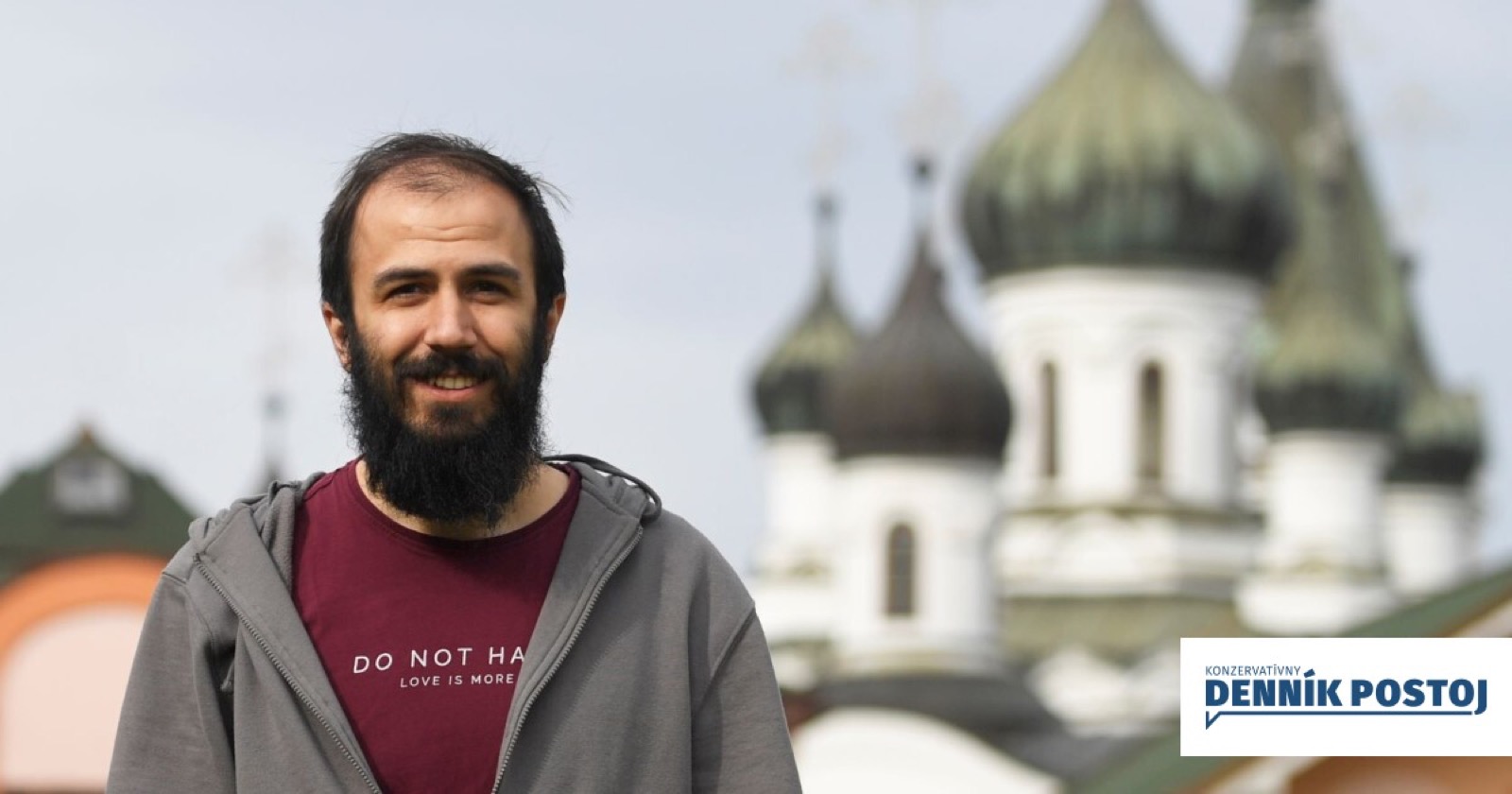
Martin Halík comes from Brno. He worked in IT, had his own company, wanted to be famous and earn a lot of money. But he decided to help. Years ago he thought about going on mission to Africa or Asia, or helping the poor in Ukraine.
In the end he settled in the Slovak region of Gemer, in the Roma settlement of Klenovec, and founded the Christian Roma Mission. He has lived there for nine years now, and partly thanks to this experience he is preparing for the calling of an Orthodox priest.
In the interview he admits his former prejudices against Roma, and also how he had to pray that God would give him love for them. He also describes how he lived with them for several months right in a Roma settlement.
Today, together with his wife, he helps Roma in five settlements, evangelises and teaches them. For his rigorosum thesis he is translating the liturgy of St John Chrysostom into the Central Slovak Romani dialect.
With friends and Christians from Brno we tried to live a good life, and little by little we reached the point where we wanted to travel somewhere on mission.
We thought about Africa, Asia or helping in Ukraine; it was just after the Maidan. Some of our friends helped pensioners there. In the end we did not manage to go anywhere, only to the Rimavská Sobota district. (Laughter.)
In this area there was a high percentage of suicides, most children had divorced parents, and many old people lived there without help.
That touched me and I felt sorry. I told myself I would try to help a little in this place. At that time I had an IT company. When the time came that my colleagues started to found families, the question came too: what next? I got the idea to buy a house in Klenovec and help here.
When I told a friend that I was starting to work with Roma, his first question was whether I had been robbed yet. So I told him yes, several times. To that he said: Good, now I take you seriously. (Smile.)
It was a kind of first test, when someone wanted to help them. But I was already prepared for it from Brno, where we have a Roma quarter; we call it the Bronx.
In Brno I did not come into contact with them, but I knew that a classmate had been robbed there and a friend of mine attacked. So I automatically avoided those streets.
I had a very negative attitude toward Roma. The situation with them seemed unsolvable to me. I even talked a friend from Canada, who wanted to go as a missionary to the Czech Roma, out of it very intensely, saying it made no sense. I said she should rather go to those who deserve it.
A moment came when I told myself that if God wants me to help them, he must give me love for them.
For example, I had an experience with a Roma man who lied to me about everything and harassed girls. I always had to deal with something about him. He promised it would not happen again, but he never kept it.
When I first came to a Slovak Roma settlement, I got frightened and I felt sorry for them. It reminded me of photos and videos from India. I had no idea that something like this exists in Slovakia. That shocked me all the more. And then it turned around.
There came a moment when I told myself that if God wants me to help them, he must give me love for them. It came so supernaturally that from one moment to the next I really did start to love them. It came from above. (Smile.) That outweighed even the bad experiences.
From the past we also have the example of missionaries who went to cannibals, and the cannibals ate them. Going to people who might steal something or lie is much easier.
Apart from my confessor, she was the first to find out that I was in the settlement. By then I had been going there for about three years. In Brno we had a little prayer group, and she began asking why I kept going to Slovakia.
She found out that I had no family or acquaintances there. Bit by bit she got it out of me. (Smile.) It inspired her, and she wanted to join a local group in Brno that helped prostitutes. But it didn't work out for her. Then, as part of a bigger event, she came with friends to our settlement, and it touched her deeply.
She wanted to help there. And that drew us even closer to each other. This is how the Lord arranged it, that the two of us now help here together.
When I was still single, I prayed that my wife would wear glasses, because I knew the Roma would not start wearing glasses until someone they respect wears them. And it helped a great deal.
I think my wife and I have managed to create a pleasant family atmosphere in which we work together and support each other.
I thought that when there is a lot of talk about something, little gets done. I knew from business that when a person shares something, he feels a sense of success and then no longer has the motivation to do it. Maybe there was no reason to talk about it at all.
My mother would worry about me if she knew. At work, people don't take that much interest in each other, and in our world people generally live more on their own. It was never a topic. If my confessor told me I should talk about it, then I talk about it.
Jesus set the bar high. He said: Whoever gave me a drink when I was thirsty, whoever gave me food when I was hungry, whoever visited me in prison, will enter the kingdom of God.
Among the Roma I find this wonderful. They are humble, they don't think much of themselves, they don't condemn everything at once, and they are willing to listen to others. That humility does a lot. They are trained in it, too. They come into a shop, want to buy something, and people are rude to them. They have to endure all of it, and it teaches them humility. Thanks to it, they are able to receive a lot.
When a person in Czechia talks with an unbeliever who knows nothing about faith, that person is open in every direction – Buddhism, Hinduism, but also Christianity.
In Slovakia, when I talk with an unbeliever or with someone who believes only on the margins, they don't want to hear much about Christianity. Esotericism or other movements interest them more.
It seems to me an experience similar to Christ's. When he came to us, he was not born in a palace but in a stable. He went among the poor and went through the deepest misery himself, so that the poor would have no trouble accepting him.
The missionaries did it the same way, too: wherever they went, they accepted the local culture and lived among the people. Then a person can understand those people better. He knows their worries and their needs – that every day you have to go for water, look for firewood, and that it is hard to wash.
A person experiences talking with people at the well – just as Jesus talked with the Samaritan woman, it is a kind of point of contact. Many things can be understood this way.
The Roma are experts at knowing what people want to hear and what story to share. (Smile.) When one political candidate comes, they nod along to everything he says, and when the next one comes, they nod along to him too. That way they get something from the one and from the other.
When a priest comes, they tell him some of their tales from the spiritual world. (Laughter.) So that everyone is content, so that the conversation doesn't stall. But once you live with them in the settlement, you can see who behaves how, and what the hierarchy there is.
They can no longer put on a show, and they take a person as one of their own. It took about five to six months before I moved into the settlement. Before that I prayed about it and looked for an opportunity, whether I should go into it. Then an opportunity opened up. One of them asked me whether I would like to live there with them.
He probably took it as a joke, but I said yes. We agreed that I would have a separate room there, I would pay rent, and I would also come to eat with them.
The first night I nearly suffocated from the smoke there, it was terrible. (Laughter.) The following nights I nearly froze. I learned to live with the door open.
Gradually almost all my things were stolen, but I noticed that the more things I have, the faster they vanish. I had to learn that one dish sponge is enough for me, though I lose even that within three days. But when I buy ten, eight of them vanish within an hour. So I had to change the way I stock up when I shop.
My mobile phone, however, never went missing. Neither did my computer or my wallet. When someone there is drunk, it is more dangerous. Then everyone in the settlement pretends to be asleep and the doors get locked.
I probably wasn't afraid. At night there were voles and rats, and that does frighten a person. But with a cat it was better. (Laughter.) But was I afraid that someone would attack me there? I don't know, I think the Roma aren't quite like that.
They are not so quarrelsome and they don't have so much on their conscience, at least in our village. It is a small village, so there isn't so much of it. The greater the anonymity, as in Brno for example, the worse it is. There you already have drugs, prostitution, big money.
I try to pray about everything, and I have always had my confessor, who guided me spiritually. He said no to me, for example, when I wanted to buy horses for the children there. In his view I would not have had the time for it.
Many times I wanted to run away from there, I wanted to leave it. More than once they damaged my car, and the children ran about on my roof. Or I wanted to teach them guitar, so I handed out guitars to them, and they then broke them.
I went through many hard moments, but what helped me was that in the evening I had time with God. I went to communion and usually everything was fine again.
Every time I thought I already knew how to work with the Roma, a crisis came. But when I went there with humility, thinking I would see how it goes, then it was good.
The Roma have a wonderful quality: they know how to forgive. For example, one wife stabbed her husband with a knife, and the next day he forgave her everything and they were together. Half a year later she stabbed him again, and again he forgave her.
And after that it never happened again. Their relationship worked for several years, and it ended only when social workers stepped in, because they were on the brink of destitution.
But that forgiveness, my wife stabbed me and the next day I go and lie down beside her, is strong. They truly know how to forgive. I made mistakes there too, but every day was as if new. We forgave each other everything and went on.
Others have dealt with this problem too. In Russia there was St John of Kronstadt, who saw many alcoholics. People there lived in very bad conditions, similar to those in Roma settlements, and so-called professional begging began to spread there as well.
From the donations that believers gave him, he built a house of love of work. People there were always given something to eat and were led to work. They were taught a trade, so that they could at least work for their food.
We try to teach the children, so that as adults they can work and manage it. We encourage the adults to work. We had a problem with men who were not used to getting up in the morning, or who had no contact with anyone who could give them a job.
We set it up so that whoever needed it could come to us for flour and oil to bake bread, but the head of the family had to come. Because the man is responsible for making sure the family has something to eat.
And he had to come before seven o'clock in the morning. It is similar in the Bible, when the Israelites were travelling, manna fell to them from heaven, and so that they would not grow lazy, it melted as soon as the sun came up.
In the Roma settlement in Klenovec it happened that they began to baptize children again, and began to arrange first holy communion, which they had given up before.
So they had to get up while it was still dark and gather their food. And so it did not happen that generations unlearned how to get up and work. I believe it gradually helped the Roma too. Every time they came for flour and oil, we also asked them about work.
When someone told us they had none, we gave them contacts so they could try to get in touch with someone. Thank God, a moment came when one hundred percent of the fathers of families had found work.
At the moment only about two are without work. They hold on. Sometimes someone is let go, for example in winter, when there is less work.
Maybe so. But hunger came, and it forced them to deal with it. If not hunger, then a hungry wife who has the children to look after.
Everything is connected. We adapt to people, to what they are capable of. In Klenovec there is a larger group of active ones, above all children and young people, whom we have known since they were small. In the Roma settlement in Klenovec it happened that they began to baptize children again, and began to arrange first holy communion, which they had given up before.
The children began to pray with us, to go to confession and communion. And a few adults too. One adult has had this experience: since he started coming to pray with us, he stopped using drugs.
He thought that once he had a family, he would give up drugs too. But even when he had a child and a family, he couldn't do it. Thanks to the prayers, it worked. He says it no longer pulls him in that direction.
These generations of Roma can no longer sing or play. Since they have had televisions, they don't do it. They have many broken relationships, single mothers. After we came, relationships were put in order as well. The younger ones have stable families and it works. It was as if they lacked role models, they watched series with all sorts of relationships, and that spoils them.
With the promotion of homosexuality it happened, for example, that someone was given the label of a homosexual, and then the others began to abuse him. But when it was said that it should not be like this, the abuse disappeared.
Once, underage girls used to dance naked, and that disappeared too. It was as if a meaning of life came to them, a joy. And the meaning of life is not given by the world, but by God.
When a person believes that God exists and that someone is always watching him, whether he lies or doesn't lie, whether he lies around in bed, it is different. God has helped us greatly also in that a factory that employs two hundred people was supposed to close three times already and never closed. On the contrary, it took on more people.
One in Hnúšťa did close, but the Roma are now at a stage where they can commute to the district town for work. Three years ago that would not have been possible yet.
When I came to the Roma settlement, few children could write and read fluently. They knew their letters and syllables, but they read very slowly. I did not know how to help them, but thanks to the songs in the songbooks they learned to read fluently.
After that we wanted to help them more, so we began teaching them mathematics and logical thinking too, and we played more difficult games with them. It all came naturally. Simple things stopped amusing them; they wanted something more. They moved forward.
But then it happened that when someone left for secondary school in Lučenec, they either got into drugs or into prostitution.
White people did not automatically accept them among themselves, but other Roma did. Some of them were opportunists. They took advantage of the fact that a Roma in a new place has nobody, so they played at being a friend, gave him pervitin, and he was supposed to work for them as a prostitute or steal.
A friend told me about this case. It is very dangerous to go away from the family that protects them.
We believe we will manage to set up a secondary school here in our settlement and solve these problems. The Orthodox secondary school in Michalovce was very accommodating; it would allow them individual study. They would study with us and travel there for exams.
Cook and IT. I understand IT and can help them find work in that field. I see that they enjoy it. In the club we teach them to work with a computer and to make prints for T-shirts, which also teaches them graphic skills.
In our centre we make T-shirts to order, also for summer camps. The cook course is also quite popular among them. Girls above all say they would like to become cooks. In the future we would like to offer bricklaying too.
It only came through helping in a Roma settlement. At first I thought I would help them mainly as a businessman, finding them work and teaching them, and so I would help the region too. Then I saw that what they need more is a priest who will lead them to God, and with God's help they will become better people.
Because I come from the Czech Republic, it was hard for me. At primary school I was afraid to say that my father was a priest. Because everyone would imagine he was some kind of lecher. (Laughter.)
In the Czech Republic it was very hard to explain that priests could have wives and children. In Slovakia it is much more relaxed.
(Smile.) No, but my mum did not want Dad to walk about in his cassock or hold her hand, because everyone looked at her strangely. In childhood I carried a stigma, and thanks to it I understand the Roma better too.
A priest's pay is not large; we were not rich. There were many of us at home, and we could not buy soft drinks and the like. I told myself that syrup was still all right, but only complete beggars drink water.
When I later met rich people and found out that they too drink plain water, I started drinking it too.
It happened to a Roma friend of mine that he had no job and his money did not stretch far enough that weekend to buy himself a soft drink. So all Saturday and Sunday he drank nothing, and on Monday he came to work dehydrated.
I understand those complexes that come from poverty, and the barriers. It helps the Roma when they see my wife and me drinking plain water and not fussing over so many things – we put on tracksuit bottoms with no brand, sometimes torn, and wear old shoes. For them it matters to wear brand-name things. They know they are poor, but they do not want to look it.
They must not smell of smoke, and they must have clean hands. They do not want to be out in the sun and get dark, so they often do not want to work outside on building sites.
In the Czech Republic relations were good; here in Slovakia they seem worse to me. It is marked by the recent past. It seems to me that it works well for us in the Operation Christmas Child project, where we do not focus on differences but on how to give gifts to as many needy children as possible. We have the same goal, and that brings us together.
It is an international project of the organisation Samaritan`s Purse, spread all over the world, which tries to reach the neediest children in the world. They receive a nice gift containing basic hygiene and school supplies, but also a toy and sweets.
We have enough gifts and textbooks, but we lack parishes and church communities willing to take part.
When I was in Ukraine in a war zone five years ago, people, regardless of their political views, came together and helped those hit by the war on both sides. In Poprad, Russian and Belarusian believers were the first to start helping refugees.
Orthodox Philanthropy in Košice is in charge of a large crisis centre at the main station in Košice. Our aim is to help, whether the person in need is a Ukrainian, a Russian, a Slovak or a Roma.
In May I was ordained a deacon in the cathedral in Košice. Now I am practising as a deacon, and what comes next is up to God's providence and the bishop. (Smile.)
I don't know. When I came, I took it that I might perhaps stay for the rest of my life. From the past I remembered that missionaries who came to us in the Czech Republic after the fall of communism often left after ten years and then wrote on Facebook: Hooray, America, I have that hard time in the Czech Republic behind me.
That hurt me afterwards. I would not want to do this to anyone, to be somewhere and then tell how terrible and hard it was there. (Laughter.)
At present I am here with my wife and three children, and we are happy and content. We take it that the Roma have wonderful qualities. Although there are difficult things too, even those are good.
We will stay as long as God wants. We will leave if the bishop sends us elsewhere, or if they no longer want us here. (Smiles.) Then I will take it as God's will.
Reprinted in full, as published: Postoj · Svet kresťanstva, 26 June 2024, author: Jana Holubčíková. Original article or video →