From 2010 to 2019 the number of working people from marginalised Roma communities almost doubled. Poverty remained. Below are the questions people write most often. We answer only what we know for certain. Inštitút finančnej politiky, 2022
Yes, slowly. The number of working people from marginalised Roma communities rose from 24 thousand in 2010 to almost 50 thousand in 2019; poverty remained, and in 2020, 87 % of them lived below the poverty line. In the Roma settlement in Klenovec every healthy father has work; before, it was fewer than half. That is our experience, not a study. What the research says →
Inštitút finančnej politiky, 2022 · Úrad splnomocnenca, EU SILC MRK 2020 survey, p. 18In some places, yes. Research in eight villages describes a playground by a Roma settlement that was quickly destroyed, and also a town where a community centre reduced truancy and more pupils from these communities started attending secondary schools. The Slovak Academy of Sciences study says what decides it: to stay a long time in one place and not to build on handing out gifts. That is why we deal with need through work and do not give out ready-made food. What the study advises →
Úrad splnomocnenca, 2022, pp. 82 and 87 · Ústav etnológie SAV, 2010, pp. 116 and 117You don't have to. Research in the villages recorded the sentence “And who ever helped us?” as one of the most common objections. We chose the children: of the children in these communities, 91 % live below the poverty line, and of all children in Slovakia, 17 %. According to an OECD estimate, bringing the employment and labour productivity of people from these communities up to the Slovak average would raise GDP by more than 12 % by 2060. Children and school →
Úrad splnomocnenca, 2022, p. 85 · EU SILC MRK 2020, p. 18 · Ministerstvo financií SR, 2020, p. 40They come from discussions and surveys, just as people write them. Anyone who asks this way is welcome here. We answer with numbers and with what we see ourselves.
In Slovakia, 82 % of people think that the benefit system favours Roma people. The benefit for people in material need is now 89,70 € a month for an individual and 314,40 € for a couple with more than four children; entitlement depends on income, not origin, and anyone who refuses work they are offered has it cut. In 2018 fewer than a quarter of people from marginalised Roma communities lived in households receiving this help, and they made up fewer than half of its recipients. Through work, not handouts →
FOCUS for the Office of the Plenipotentiary, 2024, p. 104 · Ministry of Labour, as of 12. 10. 2026 · Ministry of Finance of the Slovak Republic, 2020, p. 13972 % of people think Roma get away with breaking the law. There is no figure for crime by origin: the statistics are kept by type of offence and by district, not by ethnicity. What we do know is that recorded crime fell by more than 61 % between 2004 and 2021, and that a rising standard of living helps bring it down. We are with the children most at weekends and holidays; that is when most offences happen. What really happens to families →
FOCUS for the Office of the Plenipotentiary, 2024, p. 100 · Government Office of the Slovak Republic and the Ministry of Interior, 2025, pp. 6 to 8 · SITA in the daily SME, 2004Many do: from 2010 to 2019 the number of people working from these communities almost doubled. Still, only 23 % of people of working age have a job, against 76 % in Slovakia as a whole. In an experiment by the Institute for Financial Policy, applicants with a Roma name had less than half the chance of being invited to an interview, although their education was the same. Where we can, we look for work for a person and encourage them. What we do →
Institute for Financial Policy, 2022 · EU SILC MRK 2020, p. 17 · Ministry of Finance of the Slovak Republic, 2020, p. 111In segregated Roma settlements a woman has on average more than four children, in partly integrated localities 2,5 to 3. The birth allowance is 829,86 € for the first to the fourth birth and 151,37 € from the fifth; the benefit in material need is the same for a family with five children as for one with eight. According to the Ministry of Finance, a family with no income of its own falls deeper into poverty after a child is born. The number of Roma rose from just under 403 thousand in 2013 to 417 thousand in 2019. How many people and where →
Šprocha, INFOSTAT, 2014, p. 158 · Ministry of Labour, as of 12. 10. 2026 · Ministry of Finance of the Slovak Republic, 2020, p. 148 · SME, 2020Part of that is true: a third of the people in Roma communities, almost 90 thousand, live in informal dwellings, mostly in houses that were never officially approved and in shacks. Two thirds live legally. About 100 thousand people have no waste bin of their own at the house, and almost 6 % of settlements have no access to waste collection. In the DOM.ov project, families first save and then build their own legal houses with their own hands. How people live in the Roma settlements →
Atlas rómskych komunít 2019, pp. 18, 40 and 68 · Ministry of Finance of the Slovak Republic, 2020, p. 164 · projektdomov.skMany do help themselves: 117 thousand Roma live among other residents, and in the DOM.ov project families save at least 120 € a month and then repay a loan on their own house for 18 years. The research also noted that whoever tries to break away from the settlement is often seen by their own people as “one who left”. A study by the Slovak Academy of Sciences says that change lasts best when the whole community goes through it. With us, six students, with the scholarship and with their father, repaired a shack, added a room or built a new house. Who is helping →
Atlas rómskych komunít 2019, p. 17 · projektdomov.sk · Office of the Plenipotentiary, 2022, p. 80 · Institute of Ethnology, Slovak Academy of Sciences, 2010, p. 12Children from these communities miss more lessons than others. One reason is the road: every fourth settlement outside a village is more than two kilometres from the nearest village with a school. In two thirds of families with small children in these communities, Romani is spoken at home. Parents cannot simply not care: for truancy they lose the child allowance and can even face prison. What really happens to families → Why the beginnings are hard →
Ministry of Finance of the Slovak Republic, 2020, p. 14 · EU SILC MRK 2020, p. 16 · Central Office of Labour, 2018You are right to ask. In 2025 the Supreme Audit Office wrote that money for supporting Roma communities is spent without anyone assessing what good it actually does; the Office of the Plenipotentiary alone manages almost 400 million euros from European sources. About our own money we can say this: in 2025 our costs were about 16 900 €, gifts about 3 000 €, and every gift can be seen on the transparent account. What has really helped in ten years →
Supreme Audit Office, 31. 1. 2025 · Transparent account, Fio bankaYou are not alone in this. A mostly bad experience is reported by 33 % of people in Slovakia, both good and bad by 58 %, mostly good by 8 %. 24 % of those asked have at some time visited a Roma household. Fr. Martin lived for four months right in a Roma settlement, so that he would really know the people. What it looks like there →
FOCUS for the Office of the Plenipotentiary, 2024, pp. 39 and 47Not only that. We are a Christian mission: we want to help poor families in their situation and lead them to God and to sound morals; Fr. Martin is an Orthodox priest. A 2010 study by the Slovak Academy of Sciences found that among Roma who became members of a church, addictions, petty crime and debts decreased the most. The same study says that the church cannot replace the state, and that it did not measure hard numbers but how people themselves experienced the change. What the research says →
Institute of Ethnology, Slovak Academy of Sciences, 2010, pp. 8 to 11 and 98We know parents who went to prison, families whose benefit was cut, and mothers who are afraid their child will be taken away. With each matter we write what we see and what the law says.
These are not our doing. They are rules of the state and of municipalities that, from what we see, have helped a great deal.
Since 2018 they may stand only in gaming halls and casinos, and a municipality can ban gaming halls on its territory. Since 2019 nobody from a household that receives help in material need may play.
Gambling Act, § 34 and § 79 Gambling Regulatory AuthorityUnder a European restriction from 2007, glues and sprays with toluene may not be sold to the public. Since 2017, at the suggestion of the mayor of Fiľakovo, the Office of the Government Plenipotentiary has reminded sellers: toluene only for those who need it for their work.
Ministry of the Interior of the Slovak Republic, press release Directive 2005/59/ECSince 2015 the European Commission has been conducting proceedings against Slovakia over the separation of Roma children in schools, and in 2023 it decided to bring a lawsuit. In our villages we see that children are no longer sent to special classes as easily as before; we do not know of a nationwide figure that would confirm it.
Public Defender of Rights, 2023Pupils and students up to 26 years old have travelled free by train since 17 November 2014. Where a village has no school, the school pays parents back for the bus every month. So a child can get to school even when there is no money at home.
Železničná spoločnosť Slovensko Act No. 322/2025 Z. z., § 15The state contributes to lunch for every primary school pupil whose parent asks for it: €2.10 in the lower grades and €2.30 in the upper grades for every day the child was at school. This applied from September 2019 to July 2021 and applies again since May 2023.
Subsidies Act, § 4A child has no pen, paper or table at home and sees no reason to learn. That is where we come in. →
Fr. Martin writes about this in his book without dressing anything up. About the book →
“I was always afraid of the Roma. In Brno I had friends who were attacked or robbed. And I did not like them at all, yet I felt sorry for them when I saw them in the Roma settlement and knew that they too need to get to know Christ.”
“One day I understood that if I do not start to love them, I can hardly speak to them about Christ.”
“It was not easy. More than once Roma people damaged the club room, stole my firewood, a guitar, food and much else. Later they broke into my house, once I was hit on the head with a stone, another time I was threatened with an axe.”
“But it is not only about the bad and unpleasant; I also experience a lot of good. Never have so many people kissed me, sober or drunk, never have so many people welcomed me, embraced me and helped me, as during the Roma mission.”
He comes from Klenovec and studied medicine in Košice. From secondary school he was supported by the Divé maky scholarship program. →
He was born in a Roma settlement. Outside it, he built a house with a garden with his own hands, and he lives in it with his family. →
“In almost ten years, a great deal has changed in Luník IX,” says a historian who has been going there since 2017. →
The Omamy accompany children up to the age of four. We would like to start the same for children from 6 to 13; for now we call it “oockovia”. We do not have permission or funding for it yet, so we are looking for volunteers and donors.
We are looking for everyone with a good heart who is willing to come and help right in the Roma settlements. Where the settlements are →
Where we have not written the answer yet, we will tell you on the phone.
Christian Roma Mission. Fr. Martin Halík is an Orthodox priest, and with his family he teaches children from Roma settlements to read, to count and to work. The mission has been registered since 14 September 2020. The whole story →
In central and eastern Slovakia. We teach in Klenovec, in Markovce and in Kačanov. At other places we work together on teaching, we have supported a parish, or we have assisted partners of Operation Christmas Child. All places on the map →
We teach children to read, write and count, and we play with them. We have a bricklaying workshop and a multimedia workshop. When we can, we look for work for a person. When someone is in need, we give flour and oil, not prepared food. What we do →
No. The Omamy are with the smallest children, DOM.ov helps adults build a house, and among the Roma there also serve the Salesians, the Greek Catholic Roma Mission and others. Who helps →
The Atlas records 1 102 concentrations in 825 municipalities. Not every one is a settlement: 194 of them lie outside the municipality. More about the settlements →
Atlas rómskych komunít 2019, pp. 17 and 33With a gift you support the teaching of children from the settlements. A month of tutoring costs 50 €. In 2025 the costs were about 16 900 €, and gifts about 3 000 €. We paid the difference from our own income. In 2026 the costs so far are about 70 000 € and gifts about 20 000 €.
Where a gift goes: romamission.eu, Frequently asked questionsYes. The account is transparent, every gift is publicly visible: SK66 8330 0000 0026 0188 7523, Fio banka.
Transparent account, Fio banka, as of 12. 10. 2026Not yet. The mission is not in the notary register of recipients for 2026; you can help with a gift.
Notársky centrálny register určených právnických osôb, as of 13. 10. 2026Yes, especially children's clothes and trainers. What helps and where to send it →
We will send you the budget and the figures for the whole year. For companies and foundations →
By card, Apple Pay or Google Pay, monthly or once. Or by transfer to the transparent account. Support →
We use Christian materials. If that goes against your conscience, get in touch with us anyway. Operation Christmas Child is a project for Christians.
Leave us your phone number. We will get in touch. Get involved →
We use the number only to get in touch with you.
Teach and play with Roma children. The first two years in a community are mostly play, and little by little more and more teaching is added. Volunteer →
Yes. You can join a mission trip for one to two weeks, in spring and in summer. Get involved →
In the mission house by the settlement in Klenovec there are rooms for guests; the mission centres have lodging for groups.
We are looking for people who will teach children and play with them. Whether you need teacher training, we will tell you on the phone. Teachers and tutoring →
The law says that anyone under 18 can be a volunteer only with the consent of a legal guardian and under the supervision of a responsible adult. From what age we take people, we will tell you on the phone.
Act no. 406/2011 Z. z., § 3 para. 3The page for missionaries and parishes is written for Christians. Missionaries and parishes →
A project for Christians. Whoever wants to join leaves a phone number, and we get in touch. Operation Christmas Child →
The Czech Television documentary Ajťák z osady is 26 minutes long. In all, there are 33 reports, articles and videos about the mission. Documentary → All reports →
Slovak Television is broadcasting the new report on Sunday 18. 10. 2026. Once it has aired, you will find it among the reports.
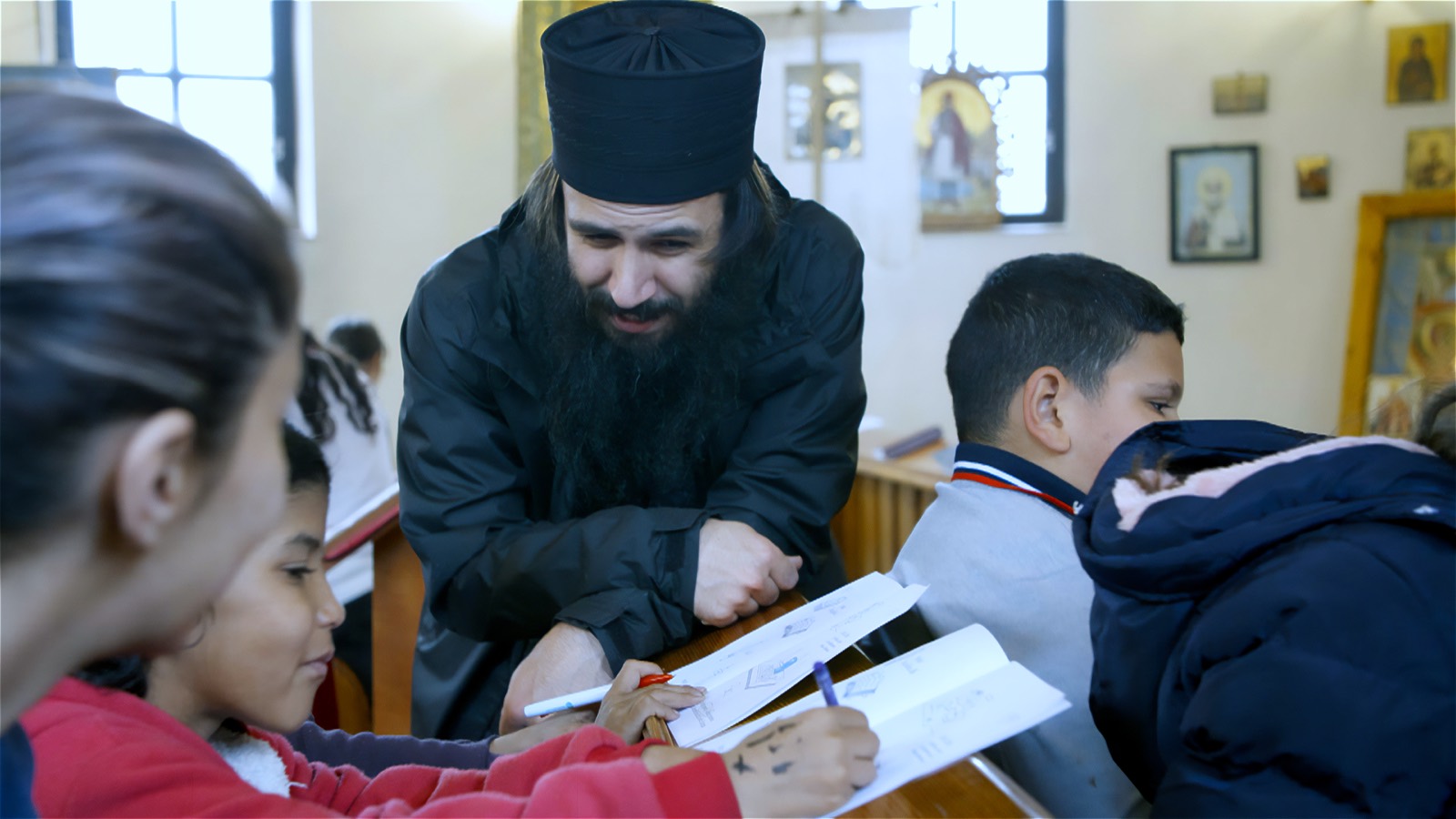
Česká televize · 26 minDocumentary Ajťák z osady
martin.halik@krm.sk
+421 951 230 015
michaela@krm.sk
+421 944 251 472